
Suggested read: Standing Margin of Stability as a Measure of Balance for people with Multiple Sclerosis (MS) [1]
Global Margin of stability
The Margin of Stability (MoS) is a measure of the amount the centre of mass (adjusted based on it’s velocity) must move before someone will fall if they take no corrective action [2].
The MoS is conventionally measured in the Anterior-Posterior and Medio-Lateral directions, in my paper I introduce a new measure, the Global MoS, the shortest center of mass shift in any direction that would result in an unstable state.
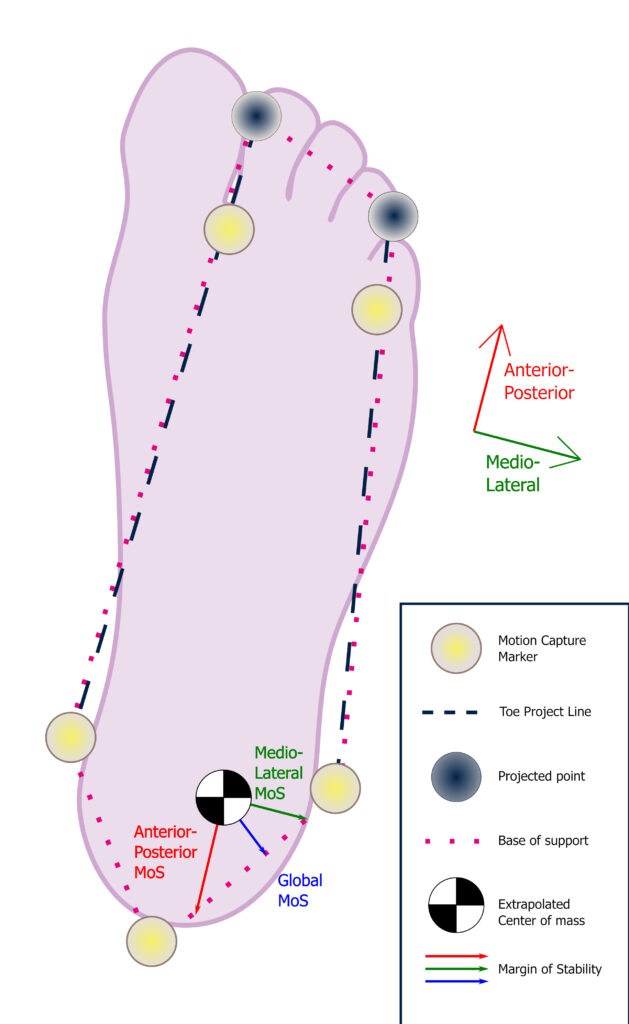
Figure by Olivia F. Simpson, included as Figure 2 in the paper on the Standing MoS [1]
Standing Margin of Stability
The Margin of stability was developed for exploring balance in walking, and it has remained used primarily in walking studies, but in this work I analyse the standing of people with MS using MoS, for what I believe to be the first time.
Standing Margin of Stability and Multiple Sclerosis
I have shown that the standing Margin of stability is correlated with established measures of impairment due to MS.
This work also shows that the Global Margin of stability is a useful change to traditional methods of calculating the MoS.
Across the anterior-posterior, medio-lateral and Global standing MoS the measures of spread (Range and standard deviation) were best correlated with the level of balance impairment.
I conclude that the Range of the Global Margin of Stability when standing has the strongest correlation with impairment due to MS.
[1] Simpson OF, Stanev D, Pitt-Francis J, Zanon M, Rinderknecht MD, Zavatsky AB. Standing margin of stability as a measure of balance for people with multiple sclerosis. Clinical Biomechanics. 2025 Nov 7:106696. (doi.org/10.1016/j.clinbiomech.2025.106696)
[2] Hof AL, Gazendam MG, Sinke WE. The condition for dynamic stability. Journal of biomechanics. 2005 Jan 1;38(1):1-8.