
Research

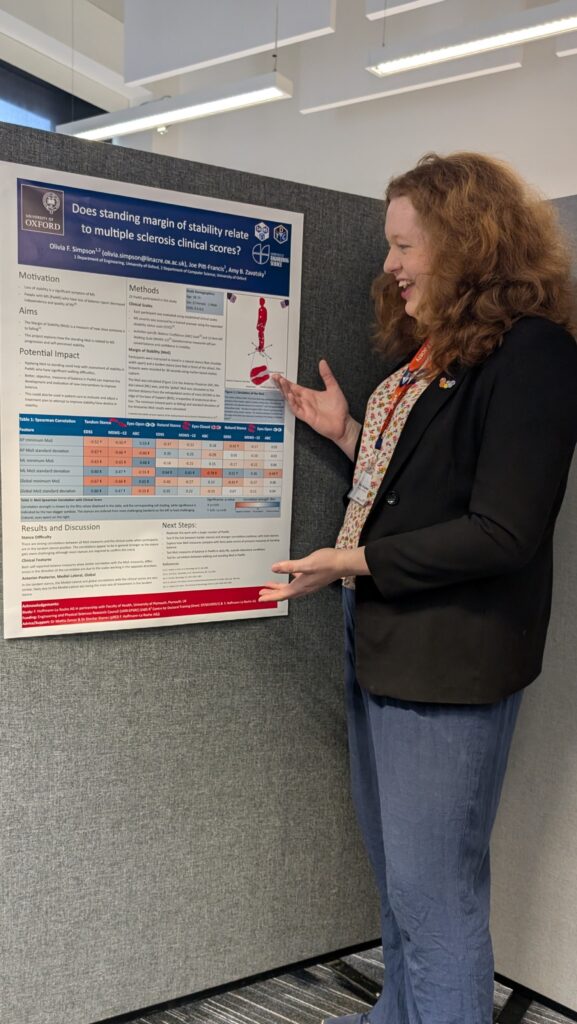
Olivia Stood in front of a poster presenting her research.

I am passionate about exploring how innovations in science and technology can come together to improve people’s lives.

Why Research?

I do research because: I love doing a new thing, then being the first person in the world to know something (no matter how niche), but then sharing that discovery to advance our collective knowledge.

What Research?

My research sits at the intersection of the life and physical sciences, applying techniques from the physical sciences to problems from the life sciences. I enjoy using the skills I have developed in one problem domain, to another problem domain.

While my research is generally not patient facing, I see ways in which all of my research so far could improve people’s health. I enjoy doing research where there is a clear positive impact on the lives of others.

Skillsets

Sensors and Instrumentation

From detecting protein conformation and neuronal impulses to motion capture and IMUs tracking how people balance, I have experience with (developing and) using a range of instruments to observe physical changes in biological systems.

To understand and help interpret the outputs of these instruments, I have significant experience in data/signal processing.

Software Engineering

Code written as part of research is frequently limited, unreliable, and difficult to fix when it breaks. My doctoral training centre training year focused on software engineering where I learnt to write reliable, sustainable and maintainable code which can be shared and expanded on by other researchers as part of the collaborative process of research.
In addition to learning and applying these principles in my own work, I have taught Software engineering to Undergraduate and Postgraduate students at the University of Oxford.

Wet Lab​

Sharing significant portions of my undergraduate degree with Biomedical Sciences students, I developed my wet lab skills through a diverse range of taught practicals.

My research has spanned Cell Culturing, through to Organic Synthesis, and Spectroscopic Analysis of environmental samples.

Research Domains

Biomechanics

My DPhil (PhD) has focused on the Biomechanics of balance in people with multiple sclerosis.

The Research group I am a part of focuses primarily on lower limb biomechanics (Zavatsky group).

Drug Discovery

Work across the early stages of Drug Discovery, from developing models for Protein-Ligand binding affinity prediction, to developing a tool for automated robotic organic synthesis of small molecules for crystallographic screening.

Cellular Biology

3D Bioprinting scaffolds with growth factor gradients and culturing MESCs. In vitro multi electrode arrays.
Developing a Terahertz transmissometer for detection of protein
conformation/Phosphorylation in platelet proteins.

Infection modelling

Expanding and evaluating an SEIR model for COVID-19 infection recovery and reinfection. In partnership with a Pharmaceutical company to inform supply chain decisions.

Microplastic flow

Interdisciplinary research developing methods (including methods for sample collection and analysis) for modelling the flow and impact of microplastics through an inland-aquatic ecosystem.

DPhil (PhD) Research

Other pages on my DPhil research will be made visible upon publication of the corresponding journal article

Other Research

August, 2019

Modelling Microplastic flow

School of Biological Sciences,Universtiy of Reading Undergraduate Research Opportunities Programme, Universtiy of Reading The Royal…

August, 2019
October, 2018

Multielectrode Arrays

Brain Embodiment Laboratory – University of Reading School of Biological Sciences, University of Reading Following…

October, 2018

Scroll to Top