
XChem – Dimond Light source/University of Oxford
Center for Medicines Discovery – Nuffeild Department of Medicine, University of Oxford
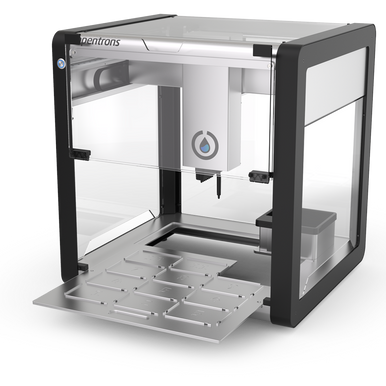
Opentrons2 fluid handler – Image from opentrons.com
The process of developing drugs from concept to market is expensive and time consuming. The COVID19 pandemic clearly demonstrated the need for speed and cost improvements in the early stages of drug discovery. The tool allowed users to input desired molecules (either using computational chemistry notation, or visually as a structural formula), the tool would then design the synthesis of the desired molecules from readily acessable precursors, and convert that synthesis into a set of precursors required, and a protocol for the robot.
This project used an Opentrons fluid handler robot which could reliably and repeatably pipette fluids. The tool used a computational retrosynesis to identify potential approaches for the synthesis, and evaluated the approaches. I developed a system to select the synthetic methods to use, identify the precursors and generate a set of multi-well array orders, sequence the synthetic tasks required, generate the code for the fluid handler to execute the synthesis, and generate human-readable instructions and descriptions for the reactions.
The work has since been further developed by testing the implementation of more complex reactions, and evaluation of the resultant products,by Grosjean et. al. [1] .
[1] Harold Grosjean, Anthony Aimon, Storm Hassell-Hart, Warren Thompson, Lizbé Koekemoer, James Bennett, Anthony Bradley, Cameron Anderson, Conor Wild, William J. Bradshaw, Edward A. FitzGerald, Tobias Krojer, Oleg Fedorov, Philip C. Biggin, John Spencer, Frank von Delft. Binding-Site Purification of Actives (B-SPA) Enables Efficient Large-Scale Progression of Fragment Hits by Combining Multi-Step Array Synthesis With HT Crystallography. Chem. Int. Ed. 2025, e202424373. https://doi.org/10.1002/anie.202424373